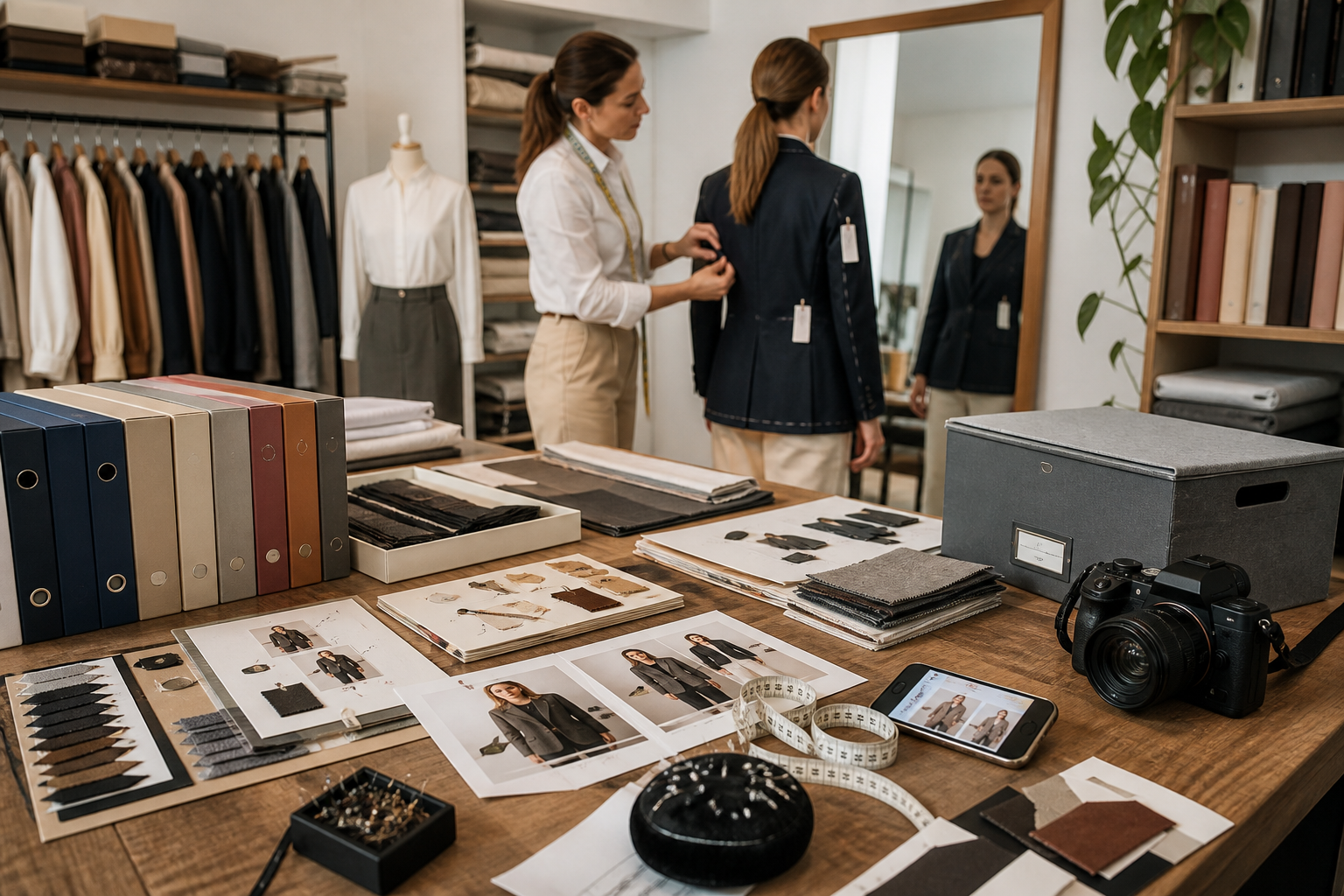

The reality for many garages
There’s something curious about the world of sewing.
We can spend hours choosing the perfect fabric, calculating a pattern with millimetre precision or adjusting a sleeve until it falls exactly as we imagined.
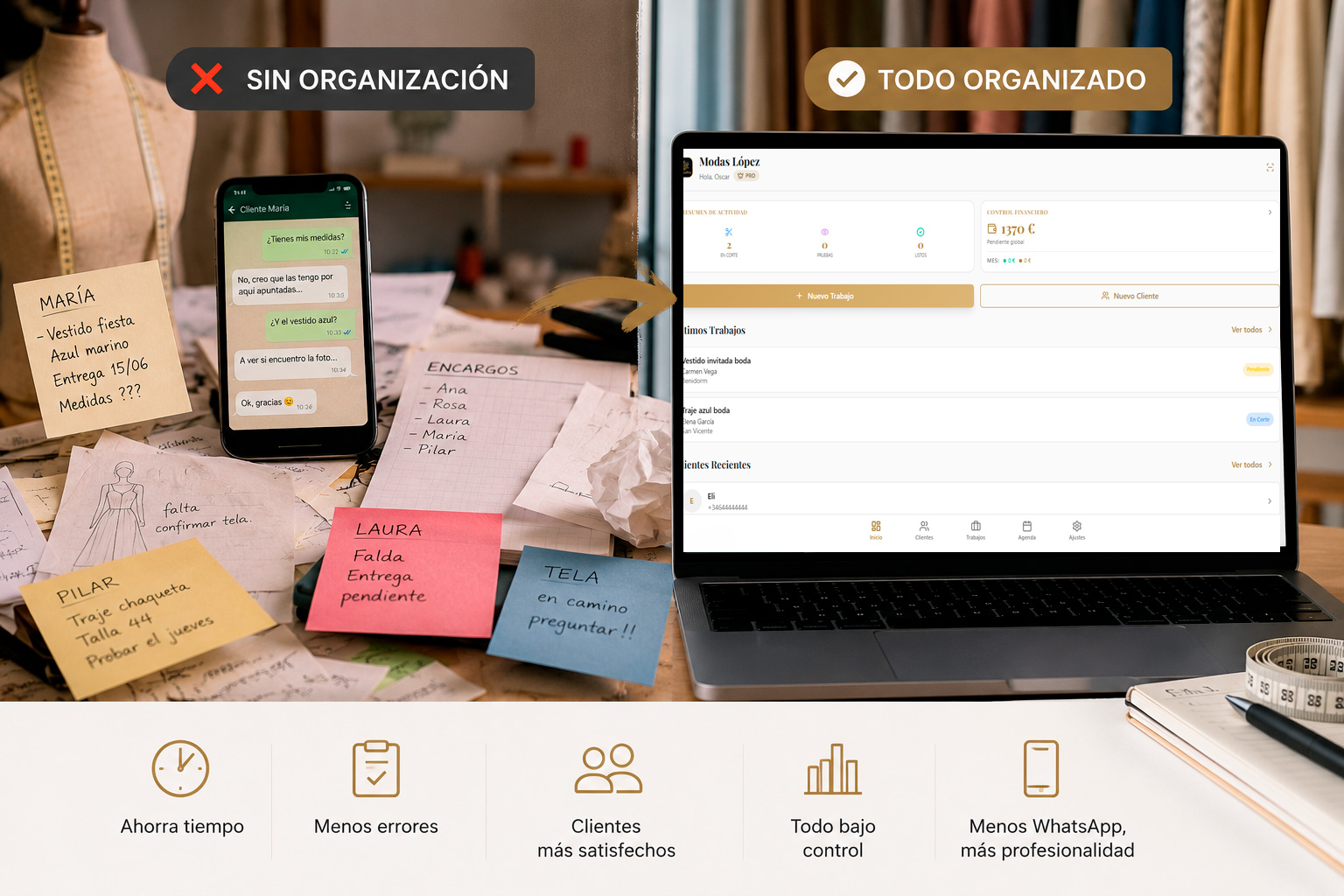
However, all that precision often goes out of the window when it comes to organising customer information.
A notebook.
A WhatsApp message.
A photograph of some measurements.
A piece of paper in a drawer.
A note jotted down in a hurry whilst the next customer waits.
It is not because the professional is disorganised.
It’s because he’s been working like that for years.
And that system works… until it stops working.
The real problem isn’t the measures
When people talk about digitising a sewing workshop, they usually think straight away of recording measurements.
But the measures are rarely the biggest problem.
The tricky bit is remembering everything else.
For example:
- Which fabric did that customer choose?
- Was the dress V-neck or strapless?
- Was the test scheduled for Thursday or Friday?
- Had I asked for the hem to be raised by one centimetre?
- Has the first quote been received yet?
When a workshop starts to grow, each customer ceases to be merely a set of measurements.
It becomes a project.
And every project generates information.
Illustrative image (IA)
How much time does a workshop actually waste looking for information?
Few people do this calculation.
Let’s imagine a workshop with 60 active customers.
If every day just:
- 2 minutes looking for a card.
- 3 minutes spent going through messages.
- 2 minutes checking old measurements.
We’re talking about approximately 7 minutes per customer.
In the space of a week, several hours can slip away simply spent looking for information.
Not sewing.
Not designing.
We are not seeing customers at the moment.
Just having a look.
The notebook is not the enemy
I’d like to dispel a myth here.
Notebooks aren’t bad.
In fact, many professionals continue to use them because they are quick, convenient and have been part of the trade for decades.
The problem arises when the notebook becomes the only place where the information is stored.
Because a notebook doesn’t allow you to:
- search by name;
- filter customers;
- access from another device;
- share information with a colleague;
- Recover data in seconds.
It is not a question of abandoning the traditional method.
The aim is to avoid relying solely on him.
The difference between storing information and being able to find it
There’s a huge difference.
Many garages keep the information perfectly safe.
But when they need it…
They don’t know where it is.
Organising a workshop means that any important information can be found in a matter of seconds.
Not in ten minutes’ time.
Not after going through forty conversations.
Not phoning the customer to ask them something they’d already said months ago.
Illustrative image (IA)
What information should any dressmaker, tailor or fashion house keep?
Every professional has their own method.
However, a complete record should normally include:
Personal details
- Name
- Telephone
Measurements
- Basic measures
- Advanced measures
- Postural observations
Commission
- Type of garment
- Status
- Expected date
- Delivery date
Design
- Photographs
- References
- Notes
- Fabrics
Budget
- Amount
- Payments made
- Pending
History
- Previous work
- Customer preferences
- Comments
The more organised this information is, the less the professional will have to rely on their memory.
The customer also notices this level of organisation
We often think that organising a workshop simply improves our work.
But the customer notices it too.
When a dressmaker can find the details of an order straight away, it shows she is professional.
When you recall a detail that the client mentioned weeks ago, it inspires confidence.
When he answers with confidence, he conveys a sense of calm.
Organisation is also part of the customer experience.
Digitising a workshop does not mean losing the human touch
There is a certain amount of apprehension about using digital tools.
As if incorporating technology would make the artisanal nature of the craft disappear.
In fact, the exact opposite is true.
The less time a professional spends searching for information…
You can spend more time listening.
Let's give it a go.
Let’s get designing.
Let's get creative.
Technology is no substitute for craftsmanship.
It protects it.
Illustrative image (IA)
Organisation also reduces errors
A measurement error can cost hours of work.
A forgotten test can cause a delay of a whole week.
A lost quote can mean a customer who never returns.
Most of these problems do not arise due to a lack of experience.
They arise due to a lack of organisation.
The future of the workshop remains rooted in craftsmanship
Sewing will always be a craft where your hands matter.
Wherever you like.
The experience.
And customer service makes all the difference.
But that does not mean that the organisation should remain the same as it was thirty years ago.
These days, there are tools available that can save time without changing the way we work.
And that allows professionals to devote more energy precisely to what no technology can do for them:
Create.
Conclusion
Every workshop has its own method.
Some people still use a notebook.
Other spreadsheets.
Other WhatsApp conversations.
It is not the system that matters.
The important thing is to ask yourself a very simple question.
If a customer were to ring you tomorrow to enquire about an order placed eight months ago… would you be able to find all the relevant information in under a minute?
If the answer is yes, you probably already have a solid system in place.
If the answer is no, perhaps it’s time to rethink how you organise your work.
Would you like to see one way of doing it?
In SastrePro.online we have designed an app specifically intended for dressmakers, tailors and ateliers.
It isn’t intended to change the way you sew.
Just to help you spend less time searching for information and more time creating.