

Introduction
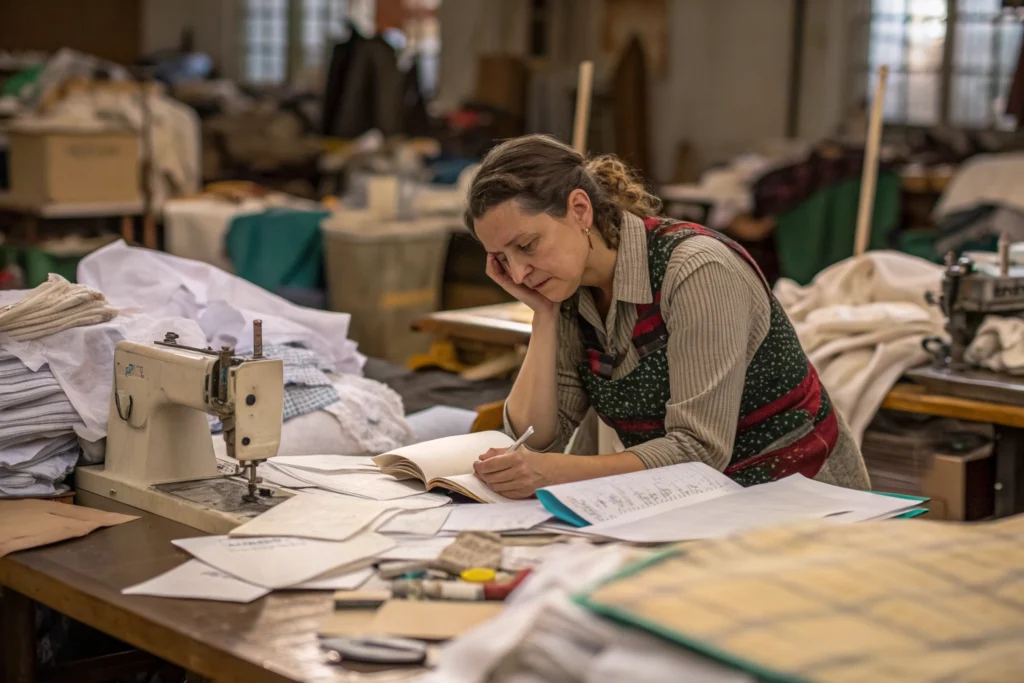
In professional sewing workshops, it is not uncommon to lose several hours each week – not because of the volume of work, but because of how and where information is stored. Measurements jotted down on loose sheets of paper, photos of fittings scattered across a mobile phone, notes in different notebooks and WhatsApp conversations create friction that slows down processes and increases the risk of errors. Furthermore, a customer’s body changes: a makeshift solution based on an old note can lead to incorrect alterations or the need to repeat fittings unnecessarily.
This article identifies specific organisational errors that lead to these time wasters in a workshop: from the management of measurements to locating photographs and fragmented communication. The aim is not to judge traditional ways of working, but to highlight where efficiency is being lost and what signs indicate that something is going wrong.
If you recognise yourself in these situations, the aim is to help you identify the key issues so that you can rectify them: it’s not about working longer hours, but about having the right information, in one accessible and up-to-date place. Below, we’ll look at the most common mistakes, their practical consequences in the workshop, and what to check in your processes to avoid them.
Error 1—Inconsistent or reused measurements that have not been checked
A measurement taken months ago may still be in a notebook, in a photo on a mobile phone or on a record that nobody has updated. When a new order comes in, finding the correct figure takes time; using the first one that comes to hand may mean having to redo the cut or the fitting. Even with a regular customer, it’s worth checking which measurements correspond to the current garment and the date of the job.
Warning signs
- There are several records for the same customer and it is not clear which is the most recent one.
- The measure has been recorded, but the date is missing or it is not clear who took it.
- Work begins using data from a previous assignment without verifying it in the new test.
What to do this week
Use a record sheet specific to each customer and order. Note down the date, the person responsible and the measurements required for that garment. If a measurement changes, keep the previous one on file for reference, but clearly indicate which measurement has been confirmed for the current job. Before cutting, check the critical measurements and record any adjustments agreed with the customer.
Mistake 2—Disorganised proofs and photos
In many workshops, photos taken during fittings are an essential resource: they show how a drape falls, where an armhole is too tight, or which pin has moved. The problem arises when these photos are scattered across your mobile, in various WhatsApp chats or stored haphazardly in the gallery. As you cannot locate them quickly and reliably, time is wasted searching for the correct version and errors in the final adjustments multiply.
Why does this happen?
- Photos are taken quickly during the test and saved «for later», without being tagged.
- Images are shared via chat to seek someone else’s opinion and are not centralised.
- There are no minimum criteria for naming or categorising the images (date, stage, client).
Consequences in the workshop
- Confusion as to which photo is from the most recent test or a previous one.
- Comparing variants is a waste of time because there is no clear nomenclature.
- Incorrect settings caused by following an outdated image or not knowing which caption goes with each photo.
- Repeating live tests to confirm something that has already been documented, resulting in a waste of time and inconvenience for the client.
Signs that this problem is occurring in your workshop
- Duplicate photos on my mobile with slight differences, and I wasn’t sure which one was the final version.
- Customers who send the same image several times because they do not receive a clear confirmation.
- Comments from the team such as «Was this photo taken before or after the adjustment?»
Best practices to implement
- Minimum naming convention: save each image as client-date-stage (for example, «Gómez_2026-05-12_test2»). This reduces ambiguity and makes it easier to carry out quick searches.
- Centralise: create a folder for each client or a space accessible to the team (local server, corporate cloud or management tool). Avoid relying solely on personal mobile phones.
- Add brief notes to each photo: state what has been adjusted, what needs checking, and the reason for the change (for example: «shorten length by 2 cm, reduce right shoulder by 1 cm»). If you’re using an app that allows comments, make use of that field.
- Save the final version: mark the photos that represent the client’s approval, or move them to a subfolder, so that they serve as a clear reference.
- Get into the habit: after each test, spend 2–3 minutes renaming and saving the images correctly. This small habit saves you hours of searching in the long run.
Implementing these practices requires some initial discipline, but it significantly reduces uncertainty when making the final adjustments and avoids unnecessary fittings. For teams who prefer a solution that brings together photos, measurements and notes associated with each order, SastrePro may be an option worth considering.
Error 3—Disjointed communication between WhatsApp, notebooks and workshops
It is common for instructions for an assignment to be scattered across WhatsApp messages, notes in diaries, Post-it reminders and verbal decisions recorded only in the memory of the person who heard them. This patchwork of sources turns every assignment into a jigsaw puzzle: context is missing, there are contradictions, and back-and-forth exchanges occur that consume valuable time.
Why does this happen?
- Speed and habit: sending a note via chat or jotting something down by hand is quicker than entering each piece of information into a single system.
- Diffuse accountability: several team members provide information without updating a single record.
- Lack of a standard procedure for receiving and verifying orders (length, linings, finishes, lead times).
Direct consequences in the workshop
- Key details may be overlooked: the agreed lining, the final length or the type of fastening may be omitted during cutting or assembly.
- Duplicate work and corrections: adjustments are made which then have to be undone due to a contradictory or incomplete instruction.
- Delays and customer frustration: phone calls or visits to clarify what had already been «discussed», creating a poor impression and wasting time.
- Reliance on one person’s memory: if the person who knows something is absent, the task comes to a standstill.
Signs that this fault is occurring in your workshop
- Jobs that start without a complete job sheet or with missing details when cutting begins.
- Repeated enquiries to the customer to clarify the same point.
- Discrepancies between what the client said and what the team delivered.
- Handwritten notes that never reach the rest of the staff or go missing from the desk.
Practical and easy-to-implement solutions
- Introduce a standard handover procedure: use a printed or digital checklist covering dimensions, lining, finishes, deadlines and the person responsible. Do not start work until the checklist has been completed in full.
- Consolidate the information on a daily basis: at the end of the working day, a designated person checks and transfers all notes and messages to the central record (digital or physical), ensuring they are not left scattered.
- Keep a record of who makes each change: add a name and date alongside any amendments to a task to avoid misunderstandings and to be able to trace decisions.
- Prefer a single channel for customer confirmations: for example, sending an order summary via text message for the customer to confirm (and filing that confirmation with the file).
- Train the team in how to use the system: whether you opt for a digital method or a standard form, take the time to ensure everyone knows how to use it and understands its importance.
For organisations looking for a centralised system that brings together measurements, photos and communications, SastrePro It might be an option worth considering.
Mistake 4—Assignments without a single record or a clear next step
An order may have the correct measurements and organised photos, but it can still be at a standstill if nobody knows what stage it’s at. «Pending» might mean that the fabric still needs to be confirmed, a sample needs to be booked, or an adjustment needs to be finalised. When the status isn’t specified, everyone on the team has to ask questions and piece together the situation.
Warning signs
- The garment has been at the workshop for days with no date set for the next step.
- Two people believe that the other has confirmed the test or ordered some materials.
- To provide the customer with information, you need to check messages and ask several colleagues.
What to do this week
Create a customised data sheet with a reference, person responsible, status and next action. Use simple statuses — for example, «awaiting materials», «in production», «fitting scheduled» and «ready for delivery» — and add the expected date. At the start of each working day, review any tasks without a defined next action. This way, the team can make progress without relying on a single person’s memory.
Error 5—Incorrectly scheduled or unconfirmed tests
A fitting appointment involves more than just the time spent with the customer. You have to prepare the garment, locate the file, make sure you have the materials ready, and allow time to note down any alterations afterwards. When the diary doesn’t account for this work or the appointment isn’t confirmed, it leads to delays, interruptions and unnecessary return visits.
Warning signs
- The customer arrives and the garment isn’t ready yet.
- The footwear or accessory required to check the fit is missing.
- A test is postponed, but the change is not reflected in the workshop schedule.
What to do this week
When booking the appointment, specify what is to be tested and what the client should bring with them. Also set aside a short period for preparation and follow-up registration. Confirm attendance via the agreed channel and note any changes on the job sheet and in the shared calendar. When you’ve finished, set out the next step and its date, even if it’s still provisional.
Mistake 6—Quotes that do not include all the time and materials
If the price is calculated solely on the basis of sewing time, tasks such as diagnosis, testing, ironing, communication and the purchase of materials are not taken into account. The workshop may be fully booked all week and yet still spend hours that are never reflected in the quote. A simple record-keeping system allows you to adjust future rates based on your own data.
Warning signs
- A seemingly quick fix requires several unplanned tests.
- Small consumables are purchased, but their cost is not recorded.
- The same type of work is repeated without knowing how long it usually takes from start to finish.
What to do this week
Keep a record of the total time spent on various jobs, not just machine time. Break down the work into diagnosis, execution, testing and finishing, and note down materials and any unforeseen issues. Then compare what was planned with what actually happened. There is no need for an identical rate for all garments: the aim is to quote for each job on a verifiable basis and explain to the customer what is included.
Error 7—Deliveries without closure or a file that is easy to retrieve
Handing over the garment does not mean that the order has been administratively completed. If the final measurements, alterations and the end result are scattered across various documents and messages, the customer’s next visit effectively starts from scratch. Furthermore, clarifying any queries about what was agreed requires piecing together a history that could have been finalised in a matter of minutes.
Warning signs
- It is not clear what adjustments were made during the last test.
- The final photos are indistinguishable from the previous versions.
- When a customer returns, nobody can find the reference for the previous job.
What to do this week
Before filing, check the delivery, record any final adjustments and keep the file, relevant photos and the agreed terms together. Use a reference system and naming convention that the team can follow. Retain only the necessary information in accordance with the workshop’s privacy policy. A brief and consistent wrap-up turns every completed job into a useful reference for the next one.